First: which kind of bill do you give?
- Registered under regular GST: you give a tax invoice, which shows the GST you charged.
- Registered under the composition scheme: you give a bill of supply. You cannot charge GST to the customer, and the bill has to say that you are a composition taxable person, not eligible to collect tax on supplies.
- Not registered (your turnover is below your state’s limit): you give an ordinary bill or cash memo, with no GST on it.
This guide is general information, checked in October 2026. GST rules and limits change, and your own case may differ. Confirm with your CA before you change how you bill.
What a tax invoice must carry
Under the GST invoice rules, a tax invoice needs these details:
- Your shop’s name, address and GSTIN.
- A serial number, unique for the financial year, of no more than 16 characters. Bills must run in sequence.
- The date of the bill.
- The customer’s name, address and GSTIN if they are registered. For an unregistered customer, these are needed when the bill is ₹50,000 or more.
- The HSN code of each item. A smaller business must show at least 4 digits on bills to registered customers; a larger one shows 6 digits on every bill.
- A description, the quantity and the unit of each item.
- The total value, any discount, and the taxable value after the discount.
- The rate and amount of tax: CGST and SGST for a sale within your state, or IGST for a sale to another state.
- The place of supply, with the state name, for a sale to another state.
- Your signature or digital signature.
Small sales: when you can skip the bill
For a sale under ₹200 to an unregistered customer who does not ask for a bill, the rules let you skip the tax invoice, as long as you issue one consolidated tax invoice for all such sales at the end of the day.
In practice, a billing app that records every sale anyway makes this simple: every sale is already on record, with its tax.
Common mistakes
- Charging GST on a bill when the shop is under composition. A composition shop cannot collect tax from the customer.
- Gaps or repeats in bill numbers, often from keeping two bill books, or a paper book beside an app.
- The same tax rate on everything. Different goods carry different rates, and the split must be right item by item.
- CGST and SGST on a sale to another state, where IGST applies.
How DukanUp handles it
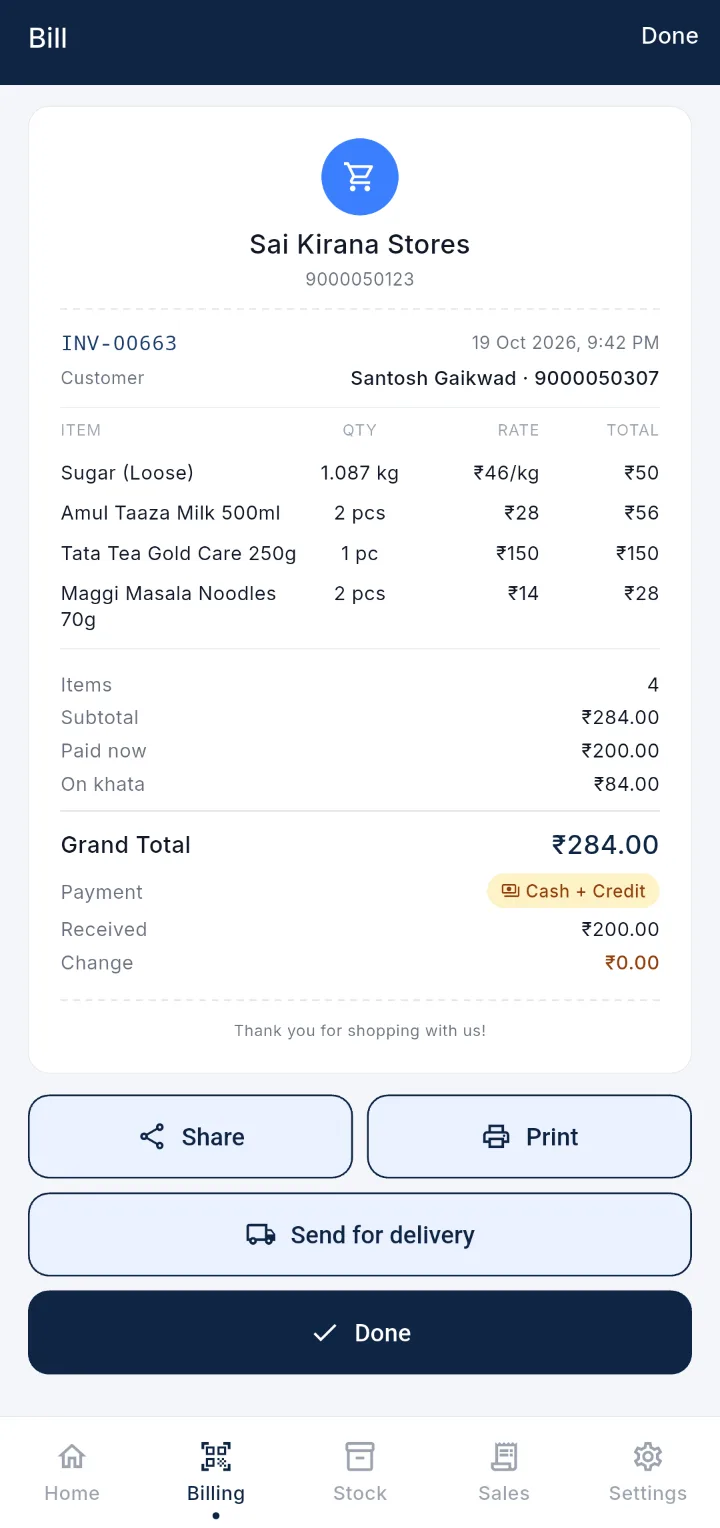
Every DukanUp bill can carry your GSTIN, the HSN code of each item and a rate-wise tax breakup. Bill numbers run in sequence on their own, and the bill goes to the customer on WhatsApp or prints on a thermal receipt or A4.
HSN codes and rates are set once per product. With the ready product list of 5,000+ packaged goods, the name, barcode and MRP are already filled in when you add an item.
Questions
Does every small kirana sale need a GST bill?
For a sale under ₹200 to an unregistered customer who does not ask for a bill, you can skip the invoice and issue one consolidated tax invoice for those sales at the end of the day. Confirm the details for your shop with your CA.
What is the difference between a tax invoice and a bill of supply?
A tax invoice shows the GST charged and is given by shops under regular GST. A bill of supply carries no GST and is given by shops under the composition scheme, among others.
How many digits of HSN code do I need?
A smaller business needs at least 4 digits on bills to registered customers; a larger one needs 6 digits on every bill. Your CA can tell you which applies to you.
